
With businesses around the world seeking solutions to operational challenges in a competitive environment, offshoring has proven to be a beneficial strategic move. One area where these benefits are highlighted is in in-house finance control roles.
This article compares South African in-house finance control salaries vs the Netherlands, showcasing how offshoring these roles can save Dutch businesses substantial amounts annually. We’ll also explore why offshoring finance control roles to South Africa is a smart move for Dutch companies looking beyond cost savings.
Financial Control Roles
Finance control is essential to ensuring a business’s financial health and compliance. Key roles within this sector include:
Problem: Rising Operational Costs
In-house finance control roles often come with high operational costs due to salaries, benefits, and overhead. This is particularly challenging for Dutch businesses that are required to pay significant employer contributions, including various social security premiums (for unemployment, disability, and healthcare) and the mandatory 8% holiday allowance on top of gross salaries. These contributions substantially increase the total cost of employment for each hire.
By contrast, South Africa’s mandatory employer contributions are minimal – usually just a small Unemployment Insurance Fund (UIF) contribution (around €9 per month) and a 1% Skills Development Levy.
These lower contributions, combined with competitive salaries, significantly reduce the total cost of employment, making South Africa an attractive option for offshoring finance roles.
Now, let’s break down the salary differences for each role and see how they impact overall cost savings.
South African In-House Finance Control Salaries Vs The Netherlands
Let’s break down the salary differences for key finance control roles and explore how offshoring to South Africa can address common operational challenges.
Financial Accountant
Financial Accountants manage a company’s financial records, ensuring accurate reporting of transactions and compliance with regulations. They typically have 3–5 years of experience and hold at least a bachelor’s degree in accounting or finance. They are generally not fully qualified chartered accountants (candidates are typically referred to as Part Qualified or Semi Seniors ).
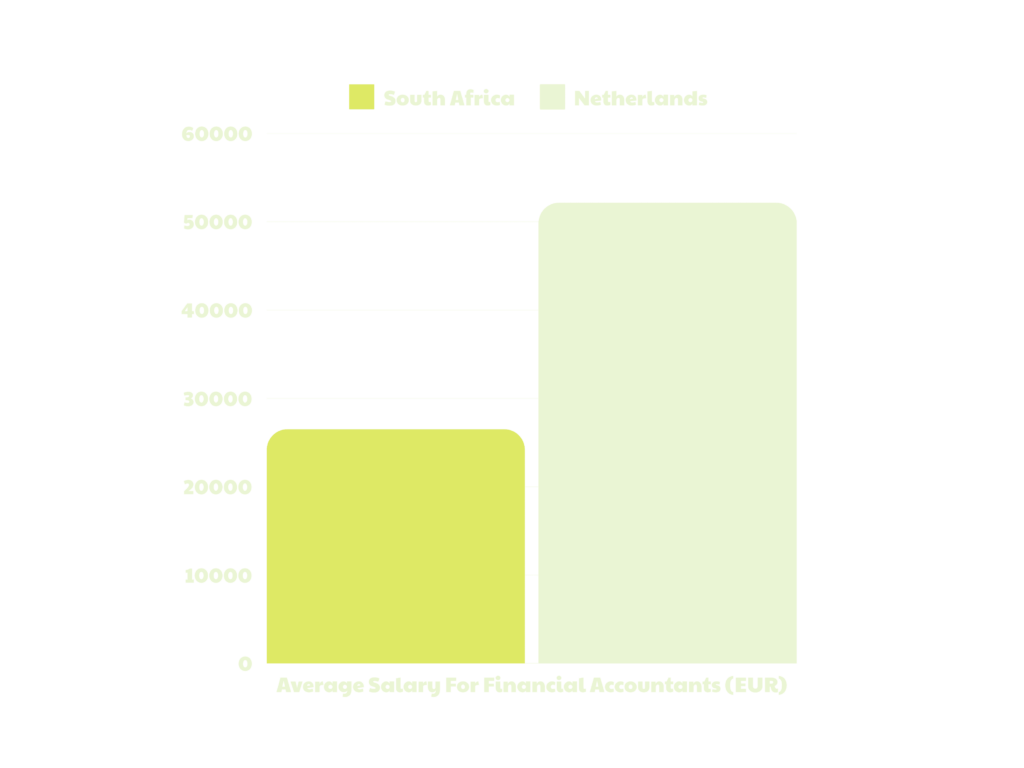
- The average annual salary for a Financial Accountant in the Netherlands (with around 3–5 years experience) is about €44,000.
- The total cost of employment after employer contributions is roughly €52,153 per year.
- In South Africa, a similarly qualified Financial Accountant would earn around €23,017 a year.
- The total cost, after including South Africa’s minimal employer contributions, comes to approximately €26,513.
By hiring a Financial Accountant from South Africa, a Dutch business can achieve cost savings of approximately 49%, translating to roughly €25,640 saved per year on this role alone.

Financial Manager

Financial Managers oversee a company’s financial operations function and ensure the accuracy of financial reporting. They typically have 5+ years of experience and, more often than not, a qualified Chartered Accountant or equivalent professional accounting designation.
- The average annual salary for a fully qualified Financial Manager in the Netherlands (with 5+ years experience in a commercial role) is around €70,000. The total cost of employment after employer contributions is roughly €82,864 per year.
- In South Africa, a Finance Manager with comparable experience would cost around €41,991 per year. The total cost, after including South Africa’s employer contributions, is about €45,487.
By hiring a Financial Manager from South Africa, a Dutch business can achieve cost savings of approximately 41%, which equates to around €33,881 in savings per year.

Financial Controller

Financial Controllers form part of the management team. They oversee the company’s financial operations and are responsible for ensuring that all financial activities and reporting are accurate, compliant, and aligned with the company’s goals. These professionals have a bachelor’s degree, often a master’s and a professional designation as a CA, CPA/ RA qualification,, and around 10 years of experience.
- The average annual salary for an experienced Financial Controller (around 10+ years of experience) in the Netherlands is approximately €85,000. After factoring in employer social contributions and benefits, the total cost of employment is about €96,083 per year.
- In South Africa, a Financial Controller of a similar caliber would earn roughly €55,000 per year. The total cost after employer contributions in South Africa is around €58,496.
By offshoring a Financial Controller role to South Africa, Dutch companies can save 39% — roughly €37,857 in savings annually for this position.

Head of Finance

Heads of Finance (also sometimes titled Group Financial Controllers or Finance Directors) are senior executives who ensure strategic financial management and compliance with all financial regulations. They usually have a master’s degree or MBA in finance/accounting and at least 10+ years of experience, with several years in senior management.
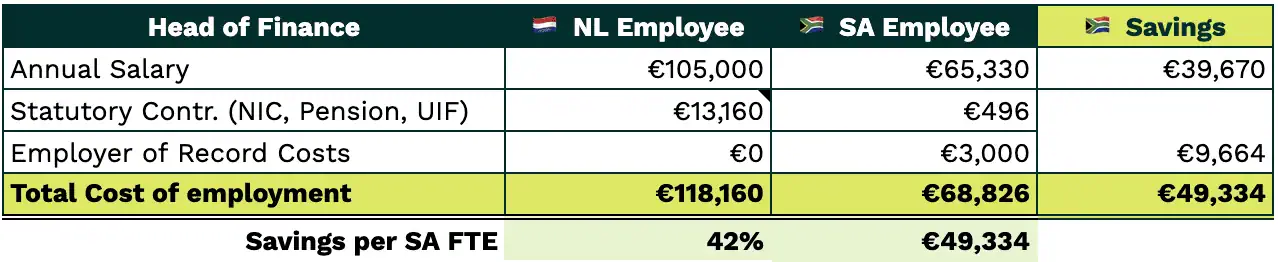
- The average salary for a Head of Finance in the Netherlands is around €105,000 per year. After including employer contributions (social security, healthcare, and holiday allowance), the total cost can reach approximately €118,160 per year or more.
- In South Africa, a Head of Finance with equivalent experience would have a salary of about €65,330 per year. The total cost of employment, after South African employer contributions, is roughly €68,826
By hiring a Head of Finance from South Africa, a Dutch business can reduce costs by roughly 42%, saving about €49,334 per year while still obtaining high-level financial leadership.
Why Offshoring to South Africa is a Smart Solution for U.S. Businesses
Offshoring in-house finance control roles to South Africa offers Dutch firms a cost-effective solution and a strategic edge by leveraging several key advantages beyond just lower salaries:
Focus On Core Business Functions

By offshoring finance control tasks, Dutch companies can redirect their internal resources toward core functions such as product development, innovation, customer service, and market expansion.
Faster Talent Acquisition

The job market for finance professionals in the Netherlands is highly competitive, and recruiting top talent can be a lengthy process. In contrast, South Africa has a large pool of well-qualified finance professionals (including many Chartered Accountants and Financial Managers) eager for opportunities.
Seamless Collaboration

Unlike offshoring to far-flung regions, offshoring to South Africa offers the benefit of near-aligned time zones. South Africa is only one hour ahead of the Netherlands (or on the same time during parts of the year), which means your South African finance team can collaborate in real time with your Dutch office.
Conclusion: A Comprehensive Solution for Multiple Business Challenges
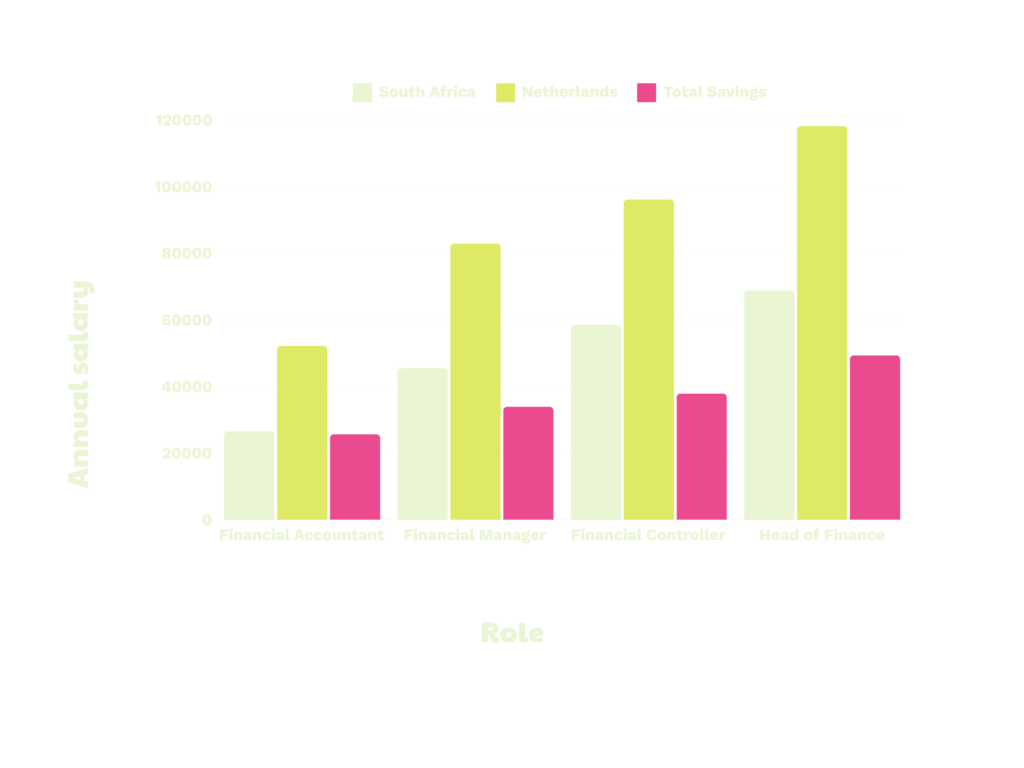
Offshoring finance control roles to South Africa offers Dutch companies a multifaceted solution to several business challenges. The cost savings are substantial – by hiring Financial Accountants, Financial Managers, Financial Controllers, and Heads of Finance from South Africa, businesses can save hundreds of thousands of euros annually in combined salary and overhead costs.
By embracing offshoring, companies in the Netherlands can streamline their operations, remain competitive in a global market, and redirect resources toward innovation and growth – all while maintaining the high financial control standards that their business demands.