
In an ever-evolving business landscape, finding ways to gain a competitive advantage can make all the difference. One area gaining a lot of attention is offshoring — specifically, offshoring finance roles to countries like South Africa.
In this article, we’ll take a look at the difference between South African public accounting salaries vs the UK, as well as how hiring South African finance talent can provide UK businesses with significant cost savings without sacrificing on quality.
Public Accounting Roles
The public accounting function plays a crucial role in maintaining the financial health of a business. There are several key roles within this sector:
The Cost Of Employment
The UK requires employers to pay National Health Insurance and National Pension Contributions. This cost of employment will be taken into consideration.
South Africa only requires a small UIF contribution of £7,56 per month and a 1% Skill Development Levy. These costs have a very small effect on the cost of employment for employers.
Let’s take a look at the difference in costs.
South African Public Accounting Salaries Vs The UK
Let’s break down each role and its function as well as compare salaries in South Africa against those in the UK.
Bookkeepers

Bookkeepers and junior accountants provide the groundwork for financial management. They make sure that all financial data is accurate and readily available when needed for more complex tasks. Bookkeepers are mostly qualified by experience (QBE) and do not necessarily have a formal degree in accounting.
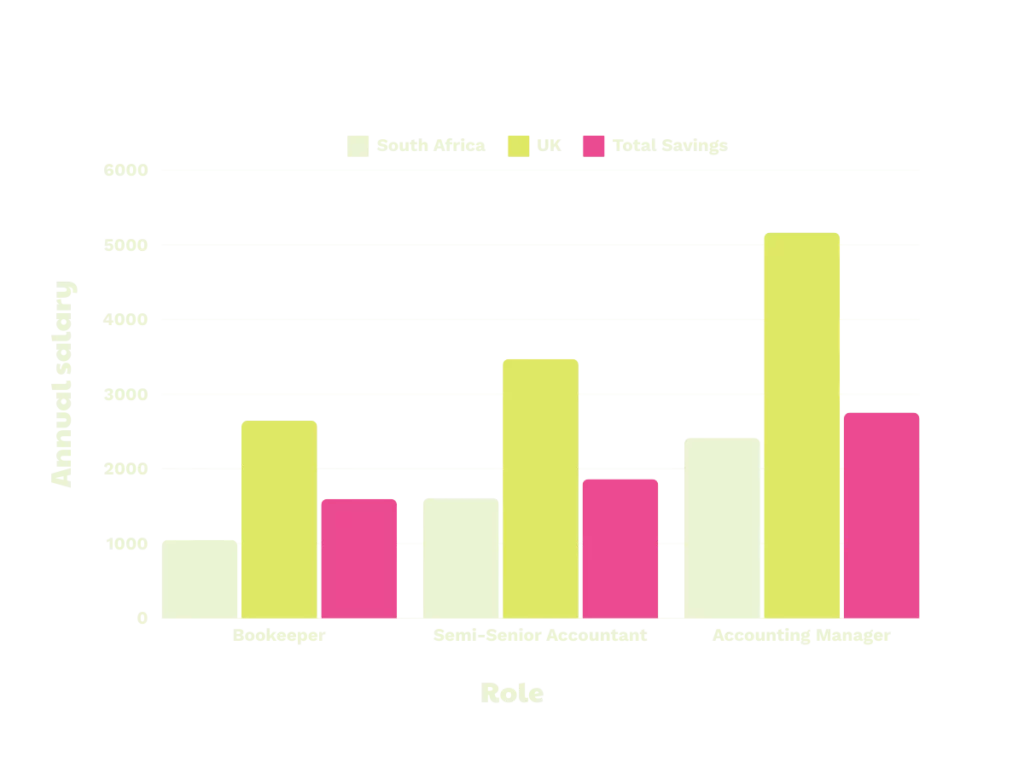
- The average annual salary for Bookkeepers is around £32,000 a year in the UK. (Salary Expert)
- The total cost of employment after mandatory employer contributions is £36,219.
- Now compare this to South Africa, the salary is around £12,000 a year. (Salary Expert)
- The total cost after including employer contributions totals £12,213 in South Africa.
This results in a 66% savings, and a savings of £24,000 per year in extra profit.

Semi-Senior Accountants

Semi-Senior Accountants take on a supportive role in accounting. They handle essential tasks that contribute to the accurate and timely preparation of financial reports. These Accountants generally have 3 – 6 years of accounting practice experience and usually have some formal post-high school education. In South Africa, these candidates commonly have bachelor’s degrees in Accounting or Finance and completed a 3-year Professional Training program. The UK sometimes refers to these Accounting professionals as “semi-seniors”.
The average monthly salary for Semi-Senior Accountants is:
- Around £42,000 a year in the UK (Salary Expert) and £48,024 after contributions.
- Around £18,000 a year in South Africa (Salary Expert) and a total cost to employers of £18,237.
A 62% savings is unlocked (or a total of almost £30,000).

Accounting Managers

Accounting Managers take on a more advanced role within the accounting function. They often lead teams and oversee the preparation of financial reports. They’re also responsible for managing a company’s financial integrity and providing strategic, data-backed financial guidance. Accounting Managers have 5 – 10 years of experience.
The average salary for an Accounting Manager is:
- Around £59,829 a year in the UK. (Salary Expert) ((including cost of employment))
- Around £28,170 per year in South Africa. (Salary Expert) ((including cost of employment))
The total savings is around 53% (roughly £31,659).

Why It’s Cheaper to Offshore to South Africa Than Hire in the UK
Offshoring finance roles to South Africa is clearly much more cost-effective than hiring in the UK. But why is that? Let’s take a look.
Lower Salary Levels

Salaries for finance professionals in South Africa are generally lower than those in the UK. This difference in salary expectations is a primary reason why offshoring can be more cost-effective.
Reduced Overhead Costs

Offshoring to South Africa reduces overhead costs associated with hiring and maintaining in-house staff. This includes expenses related to office space, equipment, utilities, and employee benefits. South African Offshoring firms often cover these operational costs, passing the savings on to their clients.
Employer Of Record (EOR) Services

An EOR acts as the official employer for your Offshored staff, handling all local employment laws, taxes, and regulations.
This arrangement can significantly reduce costs associated with legal compliance, payroll management, and HR administration. It also mitigates risks, as the EOR assumes the legal liabilities of employment, freeing your business from the complexities of international employment laws.
Conclusion & Total Savings
It’s clear to see why firms like Wilson Partners, Haysmacintyre and Burgess Hodgson to name a few, have been employing South African bookkeepers and accountants.
When comparing South African public accounting salaries vs the UK, we can see that there’s a total annual savings of £74,558.16 across these three roles. That means that offshoring your public accounting roles to South Africa is definitely an easy way to save on costs without sacrificing quality.
If you need more convincing, take a look at our blog on the benefits of hiring South African chartered accountants, or our article on why you should offshore to South Africa.